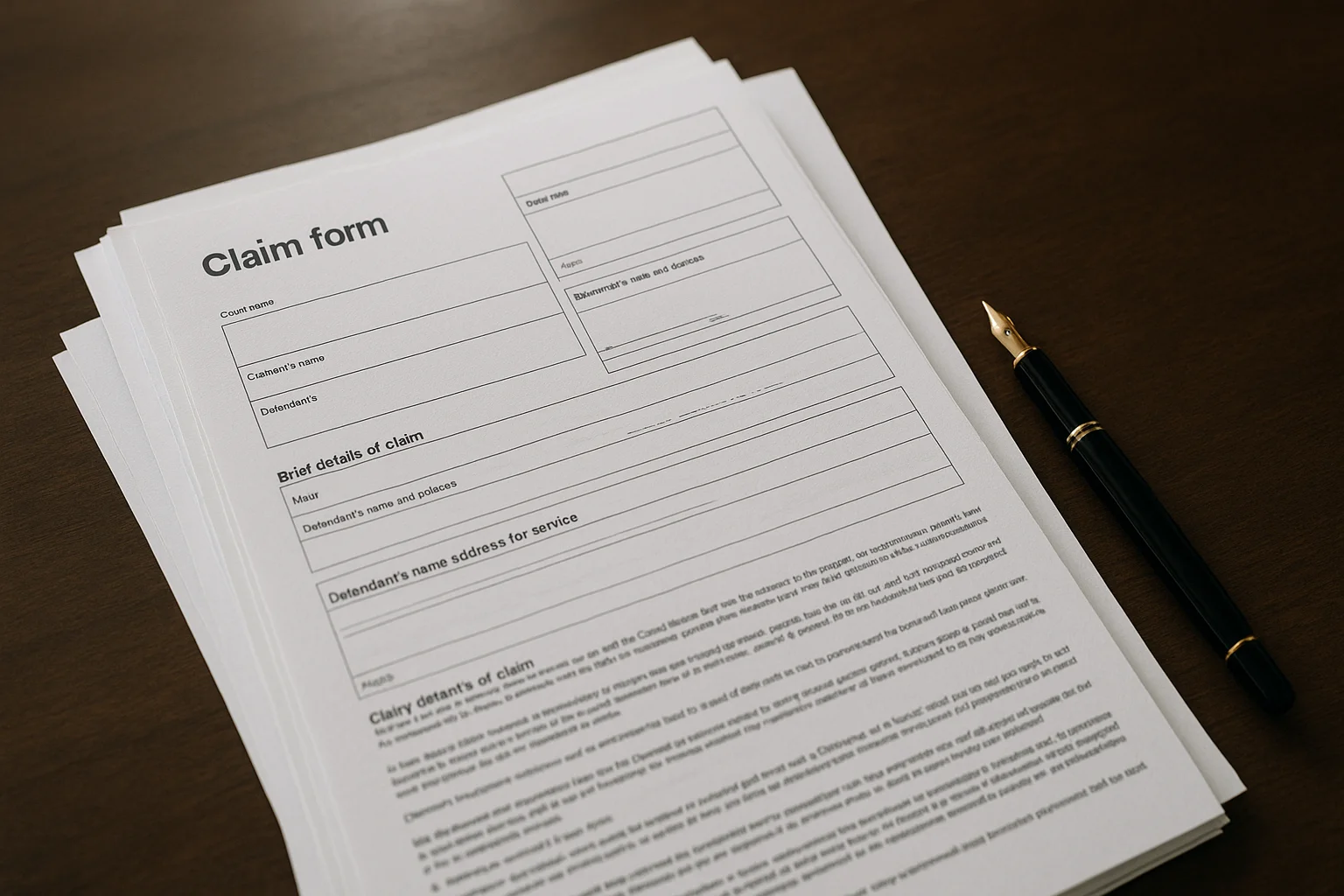
A civil lawsuit in England and Wales starts simply. It begins when one person, the claimant, files a claim form with the court. Governed by a thicket of regulations called the Civil Procedure Rules (CPR), this single act starts the clock on a series of strict deadlines and formal stages designed to resolve the dispute.
Here, we'll break down that entire journey—from filing the first form to the final judgment and what comes after. You'll learn the key terms, court procedures, and critical deadlines that define the process for everyone involved.
What Are the Key Stages of a Civil Court Case in England?
| Stage | Key Action | Standard Deadline | Governing Rule (CPR) |
|---|---|---|---|
| Pre-Action | Parties follow a pre-action protocol to exchange information and attempt settlement. | Varies by protocol | Pre-Action Protocols |
| Issuing a Claim | Claimant files a Claim Form (Form N1) with the court. | Varies (e.g., 6 years for contract) | Part 7 |
| Serving the Claim | Claimant serves the Claim Form on the Defendant. | 4 months from issue | Part 6 |
| Defendant's Response | Defendant files an Acknowledgment of Service or a Defence. | 14 days from service | Part 10 & 15 |
| Case Allocation | The court assigns the case to a procedural track (Small, Fast, Intermediate, Multi). | After Defence is filed | Part 26 |
| Case Management | The court issues directions for witness statements, disclosure, and experts. | Varies by track | Part 29 |
| Disclosure | Parties exchange relevant documents. | As per court directions | Part 31 |
| Evidence Exchange | Parties exchange witness statements and expert reports. | As per court directions | Part 32 & 35 |
| Trial | The court hears evidence and arguments and makes a final judgment. | Set by the court | Part 39 |
| Enforcement | The winning party takes steps to enforce the judgment if the loser does not pay. | N/A | Part 70-73 |
How Does a Civil Lawsuit Begin in England and Wales?
A lawsuit officially kicks off when the claimant—the one bringing the case—files a "claim form" with the court, an action governed by the Civil Procedure Rules (CPR). It’s important to remember this jurisdiction covers England and Wales only; Scotland and Northern Ireland have their own legal systems.
Filing happens in one of two ways:
- Online Portals: Straightforward money claims often use the government's Money Claim Online (MCOL) service.
- Paper Forms: For more complex disputes, the claimant fills out and files a physical
claim form(Form N1) at a County Court or the High Court.
With the claim form, or shortly after, come the particulars of claim. This is the story of the dispute. This crucial document lays out the facts, states what the claimant wants, and explains the legal reason for the claim.
Once the court gets these papers, it "issues" the claim. This means giving it a unique case number and stamping it with the court's seal. The court then sends a "response pack" to the defendant, the person being sued. This pack, containing the claim and instructions, is "served" on the defendant—and that service officially starts their deadline to respond.
What Are the Deadlines for Responding to a Claim?
Once served with a claim form, a defendant is on the clock. They have a strict deadline of 14 days to respond. Ignoring this can be a fatal mistake, so understanding the options laid out in the court's response pack is critical.
A defendant has three main choices:
- Admit the claim. This means you accept the claim (in full or part) and can arrange to pay what's owed.
- File an Acknowledgment of Service. This is a formal heads-up to the court that you intend to defend the claim. Just filing this form automatically extends your deadline for the full defence to 28 days from when you were served. It's an essential step if you need more time.
- File a Defence. You can submit a formal document that answers every allegation in the particulars of claim, explaining why you deny it or aren't liable. This must be done within the initial 14 days unless you first filed an Acknowledgment of Service.
What Happens If You Miss the Deadline?
Fail to do any of the above, and you're in trouble. The claimant can ask for a judgment in default. This is a court order issued in their favour without a trial, simply because you never replied. Once that judgment is entered, the claimant can start enforcement, like sending bailiffs to seize assets. Missing the deadline means you don't just risk losing—you might lose without ever getting to tell your side of the story.
While you can apply to have a default judgment "set aside" (cancelled), you must act fast. You'll need to give the court a good reason for your delay and prove you have a real chance of successfully defending the claim.
From practice: Court deadlines are not flexible. Many defendants mistakenly believe they can simply ask for more time informally. The only way to secure an extension for filing a defence is by filing the formal Acknowledgment of Service or by obtaining written agreement from the claimant and notifying the court.
According to official statistics for early 2026, the median time from claim to trial for straightforward small claims was 37.6 weeks. For more complex fast track and multi-track cases, it was 54.3 weeks. Those figures show just how important it is to manage the process correctly from day one.
How Does the Court Decide Which Procedure to Use?
After a defence is filed, the court allocates the case to one of four procedural "tracks." The decision hinges mostly on the claim's financial value but also its complexity, the evidence needed, and how long a final hearing might take. Each track has its own rulebook for managing the case, dictating everything from evidence and costs to the overall timeline.
Small Claims Track: This is the home for most simple disputes valued up to £10,000. Its procedures are less formal, designed so people can represent themselves. The crucial point? Recovering legal costs is severely limited. That means even if you win, you'll likely pay your own lawyer's fees.
Fast Track: Reserved for claims between £10,000 and £25,000, this track is for cases where the trial should last no more than one day. The court imposes a strict timetable and caps what can be claimed for expert witness fees. Here, the general "loser pays" rule for legal costs applies.
Intermediate Track: Introduced in 2023, this handles claims valued between £25,000 and £100,000. It's for cases too complex for the Fast Track but not needing the intensive management of the Multi-track. It uses fixed costs and is designed for trials lasting up to three days.

Multi-track: This is for all claims over £100,000 or any lower-value claim that is especially complex. The court manages these cases closely through hearings, setting custom
case management directionsfor each stage. There are no fixed costs, meaning legal bills can become substantial.
Getting allocated to a track is a pivotal moment. It effectively sets the budget, complexity, and speed for the rest of the lawsuit.
What is Disclosure and the Exchange of Evidence?
Disclosure is a cornerstone of English civil justice. Both parties must tell each other about all relevant documents they have or control—even documents that hurt their own case. The purpose is transparency. Everyone sees the key evidence before the hearing, which prevents "trial by ambush."
Standard Disclosure
Under the rules for standard disclosure, each party must perform a reasonable search for documents and then provide a list covering three specific categories:
- Documents they plan to rely on.
- Documents that hurt their own case or help their opponent's.
- Documents that support their opponent's case.
Today, this process has been reshaped by technology. Special e-disclosure protocols now exist to manage the search and exchange of huge volumes of electronic data, from emails and texts to database records.
Legal Privilege
But not every document has to be shown. Some communications are protected by "privilege." The most common type is legal advice privilege, which shields confidential communications between a client and their lawyer when asking for or receiving legal advice. Another is litigation privilege, protecting documents created mainly for the purpose of a lawsuit that is pending or likely. A party can legally withhold these privileged documents from the other side.
Witness and Expert Evidence
After disclosure, the evidence exchange begins. This typically involves two types of documents:
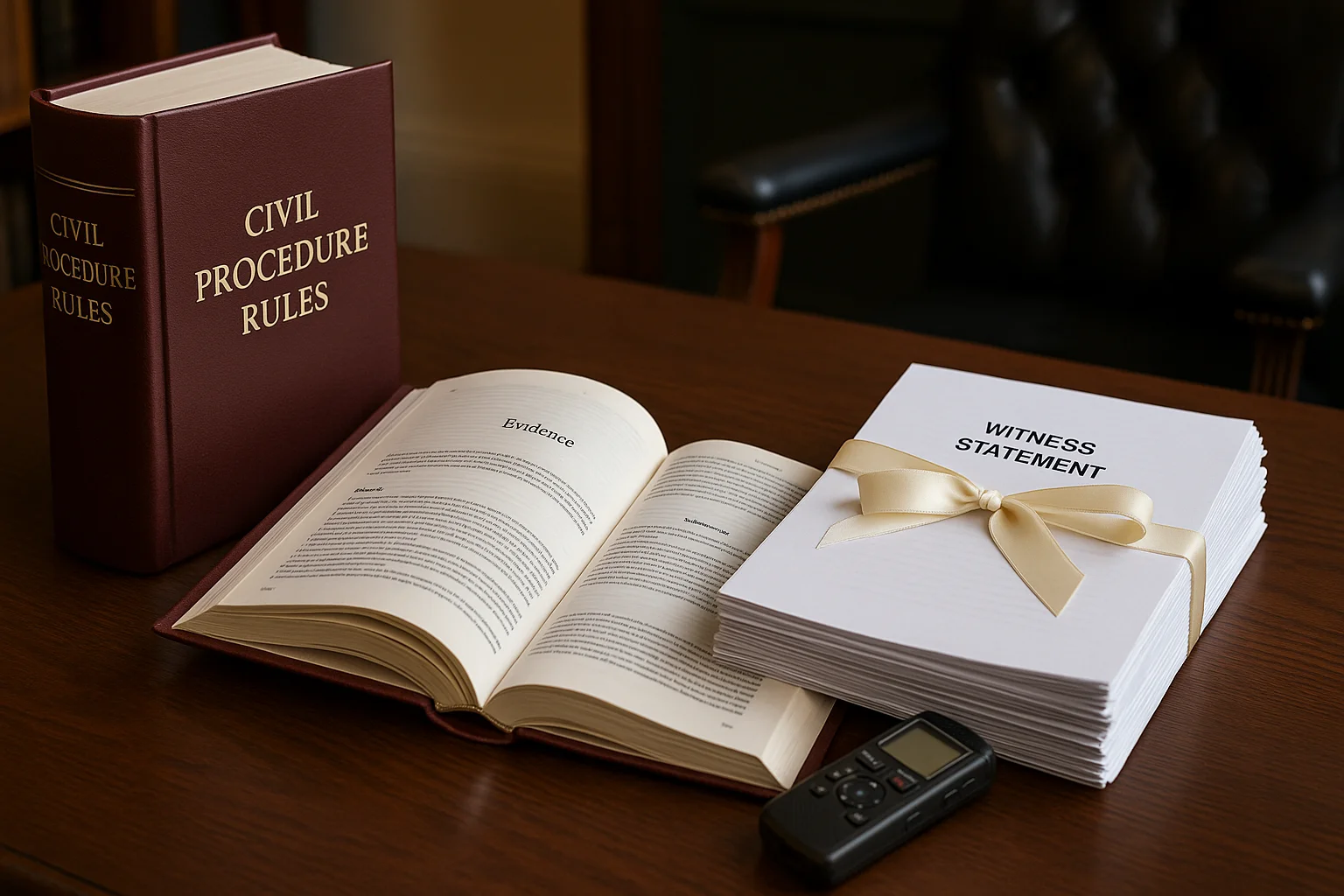
- Witness Statements: These are the written stories from people with firsthand knowledge of the dispute. At trial, these statements become their primary evidence.
- Expert Reports: For cases needing specialist insight (like medical or engineering issues), parties or the court will appoint an expert to provide an impartial opinion in a formal report.
Both sides exchange these documents at the same time, following a court-ordered timetable. They form the core evidence the judge will use to decide the case at the final hearing.
How Does a Court Hearing Work and What Happens After?
The trial—the final hearing—is what your entire case has been building towards. This isn't just another meeting. It's a formal showdown where a judge weighs the evidence, listens to legal arguments from both sides, and ultimately issues a binding decision: the judgment.
Preparing for the Trial
The weeks before a hearing are a frenzy of preparation for the legal teams. Two tasks dominate this period:
- Creating the Trial Bundle. This is a meticulously organised and paginated set of folders holding every crucial document: claim forms, witness statements, expert reports, and key disclosures. An error here, like a missing document, can be disastrous, as the judge generally won't consider anything that isn't in the bundle.
- Drafting Skeleton Arguments. Think of this as the judge's roadmap. It's a concise written summary of your case, pointing to the relevant evidence and legal principles that support your position.
The Course of the Hearing
A typical trial follows a strict, time-honored script:
- Opening Statements: First, the claimant’s barrister outlines their case. Then the defendant's barrister responds.
- Evidence-in-Chief: The claimant's witnesses are called. Their written witness statement often stands as their main evidence, which they confirm on the stand.
- Cross-Examination: Now the tension rises. The defendant’s barrister questions the claimant’s witnesses, probing for weaknesses, inconsistencies, or gaps in their story.
- Re-examination: The claimant’s barrister gets a chance to ask their own witnesses questions, but only to clarify points that came up during the cross-examination.
- The entire process then repeats for the defendant’s witnesses.
- Closing Submissions: Finally, both barristers deliver their closing arguments. They summarize the evidence and argue why the law falls on their client’s side.
Judgment and Costs
Once the arguments conclude, the judge delivers their decision. Sometimes this happens right away (an ex tempore judgment). In more complex cases, the judge might take weeks or even months to reflect before handing down a reserved judgment.
The final, crucial step is costs. In England and Wales, the "loser pays principle" is the default rule. This means the unsuccessful party is typically ordered to pay a large portion of the winner's legal fees. That said, a judge can change this order. For instance, if the winning party behaved unreasonably or rejected a fair settlement offer earlier on, their cost recovery might be reduced.
This article is published by an independent law firm for informational purposes only and does not represent or claim affiliation with any government body, international organization, or official authority.
Questions
Frequently Asked Questions
Most civil disputes start in the County Court. High-value cases (usually over £100,000) or those involving thorny legal points may be allocated to the High Court. When you file online, the system often directs your case automatically based on the value and subject matter you enter.
Before you can even start court proceedings, the Civil Procedure Rules require you to follow certain steps called a pre-action protocol. The entire point is to force an exchange of information and encourage an early settlement, hopefully avoiding litigation altogether. If you ignore a relevant protocol, the court can penalize you with cost sanctions—even if you ultimately win your case.
Appeals are not quick. According to 2025 Civil Division statistics, the average wait from filing an Appellant’s Notice just to find out if you have permission to appeal was 14 weeks . If you get permission, the data shows it could take another 31 weeks on average before your appeal hearing actually starts. This means you should budget nearly a year for the entire process, from start to finish.
Yes, you have the right to represent yourself as a litigant in person . But it’s a huge risk. The court procedures are complex and unforgiving, especially for cases on the Fast, Intermediate, or Multi-track. A simple procedural mistake can damage your case beyond repair and may lead to you being ordered to pay the other side's legal costs.
Judicial Review is a special type of court proceeding, not a standard civil claim for money. Its sole purpose is to challenge the legality of a decision made by a public body, like a government department or local council. A claim for Judicial Review must be filed fast. The absolute deadline is within 3 months from when the grounds for the claim first arose, and often the court expects you to act even more promptly than that. { "@context": "https://schema.org", "@type": "Article", "headline": "A Guide to Civil Litigation in the UK: Answering Common Questions for 2026", "datePublished": "2026-0
Contact Us
Schedule Your Free Case Evaluation Today
Share the details of your situation with our team, and we'll provide a prompt, confidential response. We're here to listen, answer your questions, and help you understand your legal options.
Send Us a Message
Reach Us Directly
All consultations are strictly confidential and protected by legal professional privilege.